What the plants are carrying.
A plant enters a culture through specific channels — a stitch, a proverb that sets the sowing date, a wedding song, a canvas. This is the index of those channels, and of what has been taken out of them.
Updated · 11 registers · 9 sources cited
01The dye came out of the ground
Start with the most literal connection between Palestinian plants and Palestinian material culture, which is also the one most often skipped: the colours are plants.
From the mid-nineteenth century to the 1940s Palestinian embroidery was worked in silk, gold and silver thread on hand-woven cotton, linen and silk, and most of those fabrics and threads were coloured with natural dyes. The deep blue of so many nineteenth and early twentieth-century dresses is indigo, a plant common in the Jordan Valley. The hallmark Palestinian red came from madder, a native plant, together with the insects kermes and cochineal (palquest, Interactive Encyclopedia of the Palestine Question).
Before a plant could be a motif, it was the pigment. A Palestinian dress is made of the same hillside it was embroidered in.
That changes what a thawb is. Not an object decorated with images of nature — an object physically constituted out of a specific landscape's plants, insects and water, by women who knew which ones and when.
02The stitch
تطريز — tatreez. The earliest surviving Palestinian embroidered dresses date to the 1840s, and the cross stitch most associated with Palestine — قطبة فلاحية, qutbah fallahiyyah, the peasant stitch — was in general use by the end of the nineteenth century. Until 1948 it adorned the clothing of rural and Bedouin women in discernible regional styles (palquest).
Nineteenth-century patterns ran to abstract geometry, chevrons, eight-pointed stars, squares, alongside stylised forms drawn from local flora and fauna: the cypress, سرو (sarw), and the palm, نخلة (nakhleh). The Bethlehem and Hebron areas are known for couching work, تحريري (tahriri), a technique whose winding cord makes floral motifs the cross stitch cannot.
The regional part is the political part. A dress's motifs, their arrangement, its colours and its cut were legible. They told you the wearer's village, her wealth and her marital status at a glance. A stitched vocabulary of place, worn.
What happened to that vocabulary after 1948 is documented in the same source: the political upheaval and the economic collapse that followed drove an intense commodification of embroidery, with radical shifts in its use and meaning. The garment that had announced which village you were from outlived the villages.
03The proverb, which is really a calendar
Palestinian farming proverbs are not decorative folk wisdom. They are scheduling instructions, and the plants in them are the instrument — a flower comes up, and that is the signal to act.
This is not a modern reading of the material. When the Palestinian physician Tawfiq Canaan set out the farming year in his 1928 study of Palestinian plant lore, he did it almost entirely in proverbs — the olive's blossom month predicting the size of the crop, the vine's leaves in March "as small as the ears of the mouse," the anemone marking April (Canaan, JPOS 8, 1928).
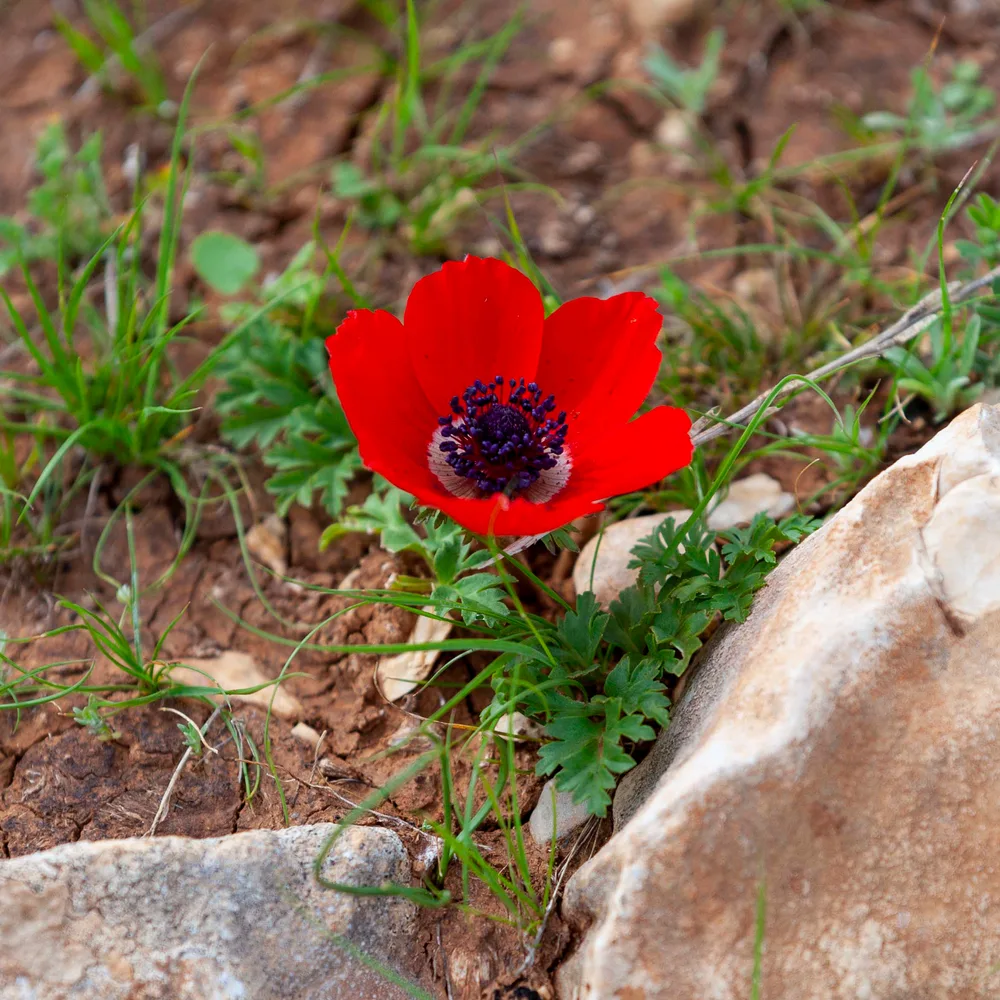
The clearest case in this record is the hannun. When the narcissus and the anemone are up, the proverb says, get your seed in the ground — and the full verse, with its sources, sits on Record 01. That is a phenological calendar encoded in a rhyme, in a place where the rains are unreliable and the planting window is narrow.
A proverb about a flower is a farmer's instrument. It stops working the moment the person holding it can no longer walk to the field.
Which is the through-line to the rest of this site. The knowledge is bound to a particular hillside in a particular week, and it transmits by walking there with someone older (Record 06, Register 04).
04The map is a plant list
Halfway through the 1928 study Canaan stops writing about belief and starts writing down addresses. He had noticed that a large number of Palestinian villages, valleys, hills and ruins are named after plants, and he set out a table of them with his own glosses (Canaan, JPOS 8, 1928, 131–132).
| Place | What the name says | Where |
|---|---|---|
| دير البلح | The monastery of the date palm | Near Khan Yunis |
| جبل الزيتون | The mount of olives | Jerusalem |
| وادي التفّاح | The apple valley | Bayt Jala |
| قرية العنب | The village of grapes | Abu Ghosh |
| كفر قرع | Pumpkin village | Near Haifa |
| نهر الدفلة | The oleander river | Near Tantura |
| جورة العنّاب | The hollow of the jujube | Jerusalem |
| بئر الورقة | The well of the leaf | Inside al-Aqsa |
| خربة الخوخ | The ruin of the peach tree | Ancient Etam |
People are named the same way. Canaan lists حنّونة hannuneh, flower, and زيتونة zaytuneh, olive, and وردة wardeh, rose, and سروة sarweh, cypress, as women's names, alongside family names taken from the branch, the olive, the prickly pear, the lentil, the pepper and the palm.
Two things follow from a list like that. The first is that this flora was never scenery to the people living in it — you do not name your daughter, or the place you are from, after a plant you have not looked at closely. The second is geographic. دير البلح Deir al-Balah is now among the most repeated place names in Gaza, and what the name says is that there were date palms there, and somebody counted them.
05The song
Two distinct modes, both in the record.
In the dal'ouna, sung at weddings and gatherings, the flower is the beloved — the hannun standing in for a red cheek, for longing, for a heart in flower (Record 01, Register 04).
And in al-Sabr, documented from Latifa Sam'an and sung by Amal Murkus, the plant is the expulsion: I carried patience with me from the day they drove us out, and the stones of the house weep for our parting (Record 04, Register 04).
The same botanical vocabulary carries a wedding and a Nakba. That is not a contradiction to be smoothed over; it is what it looks like when a people's whole emotional register runs through the plants of one landscape.
06The canvas
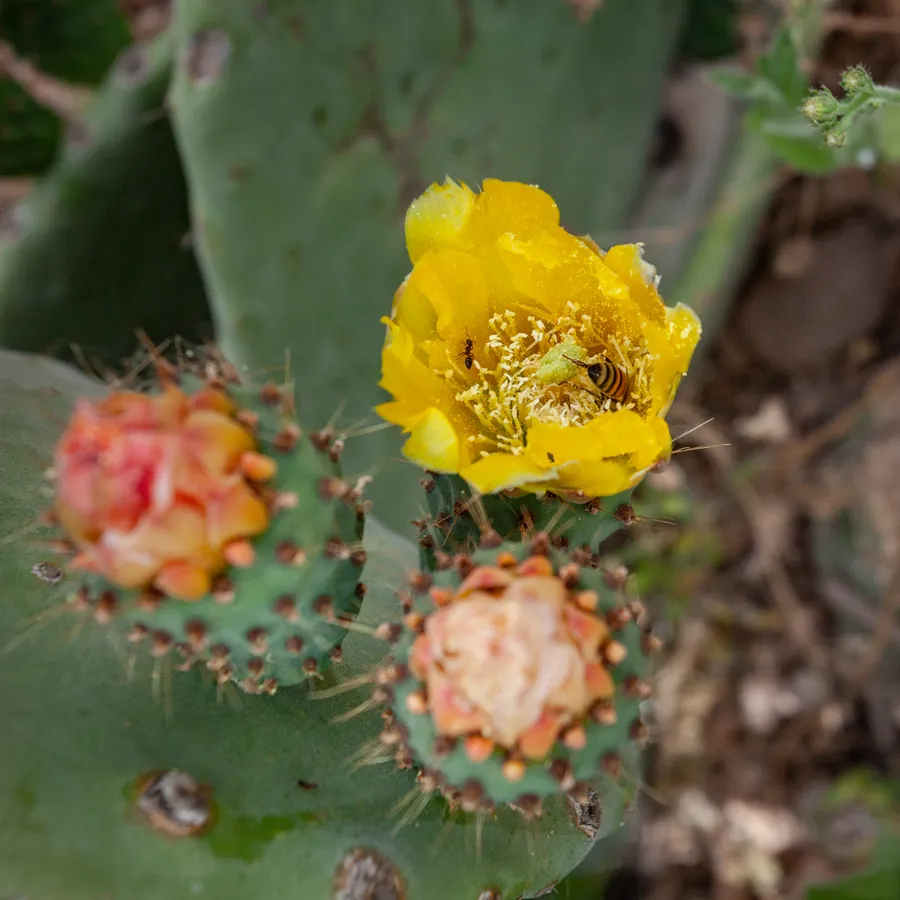
Palestinian painting has a plant at its centre, and it is the cactus.
Asim Abu Shaqra (1961–1990), from Umm al-Fahm, painted the sabr over and over — lifted out of the ground and standing in a household pot: rooted plant, made portable, made displaced. The line runs forward through Rana Bishara of Tarshiha, who sealed sliced cactus pads in pickling jars under the title From so much patience, our patience has become pickled; Fouad Agbaria of Musmus, painting cactus lifted out of the earth by a toy digger; and Ahmad Yasin of Nablus, who paints onto living pads and says he does not want a picture that ends up in a museum, because the museum is the land (Record 04, Register 04).
Four artists, one plant, one gesture repeated: take the thing that cannot be uprooted, and show it uprooted.
07Plants that are somebody
Canaan opens his 1928 study with a claim that is easy to read past. The Palestinian, he writes, lives in and by nature, and in it the heavenly bodies, mountains and caves are animated, while animals and plants are actual personified beings, which live and talk. Some are held to have powers of their own (Canaan, JPOS 8, 1928).
He then documents what that meant in practice, and the examples are specific rather than atmospheric.
- The mandrake, تفاح الجنّ tuffah al-jinn, the apple of the jinn, was held to be inhabited by demons living in its root, from where they ruled the whole plant. The root was said to be so long that nobody had reached its end, and part of it shaped like a human body. A peasant clearing one from his ground would not pull it himself: he tied an ox or an ass to the stem and drove the animal, and at the moment it came out you were supposed to hear the spirit make a horrible noise.
- The carob belonged to Saturn, the ill-omened planet, which put it and anything connected to it on the wrong side of things. In the dream table it means ruin. Canaan gives the reason the word does that work: خرّوب kharrub, carob, shares a root with خرّب kharraba, to ruin. Of all the trees, the demons are held to prefer this one, which is why the proverb says sleeping under a carob is not recommended, and why a peasant will not tie his donkey to one without first asking the jinn's permission (Canaan, JPOS 4, 1924, 36–38).
- The oak, in Turmus Ayya at least: do not fell the oak, since it is the habitation of the devil.
One line in that section is a piece of fieldwork rather than folklore, and it shows Canaan doing his job: “I have never heard that a tree was inhabited at the same time by good and evil spirits.” Springs were different, he notes, and could hold opposing powers at once. He is reporting the limits of what he was told, not tidying it into a system.
Set this beside the plants people gathered, cooked and swore by and the picture is not decorative. A hillside in this account is populated: some plants feed you, one marks April, one means patience in a dream, one is not to be cut.
08The Virgin's Hand
In the shops around the Church of the Holy Sepulchre, alongside the incense and the painted candles, pilgrims have for centuries bought a small dry plant curled root-and-all into a ball. They are sold it as the Rose of Jericho, the resurrection plant, because it opens when you put it in water. Locally it has a different name: كفّ العذراء kaff al-Adhra, the Virgin's Hand, or كفّ مريم kaff Maryam — and often, affectionately, the diminutive, the little hand of Our Lady.
Its actual use was not devotional. It was a birth charm. Kept dry in the house and brought out in a hard labour, soaked in water and held up where the woman could see it, so that as the plant opened she might open. One woman put its purpose in four words: “The plant preaches patience.” Another said they hold it up and say, if God can bring life from this dead plant, shall he not much more bring life from your life? The water it had soaked in was sometimes given her to drink (Crowfoot and Baldensperger, JPOS 11, 1931, 7–14).
The interviewers put a leading question to a Muslim woman — was kaff Maryam not the Christian name for it, while Muslims say kaff Fatima? They recorded her answer intact:
“It is Kaff Mariam, not Kaff Fatma! Our Lady Mary helps us just as much as she does you — she belongs to us as much as she does to you.”
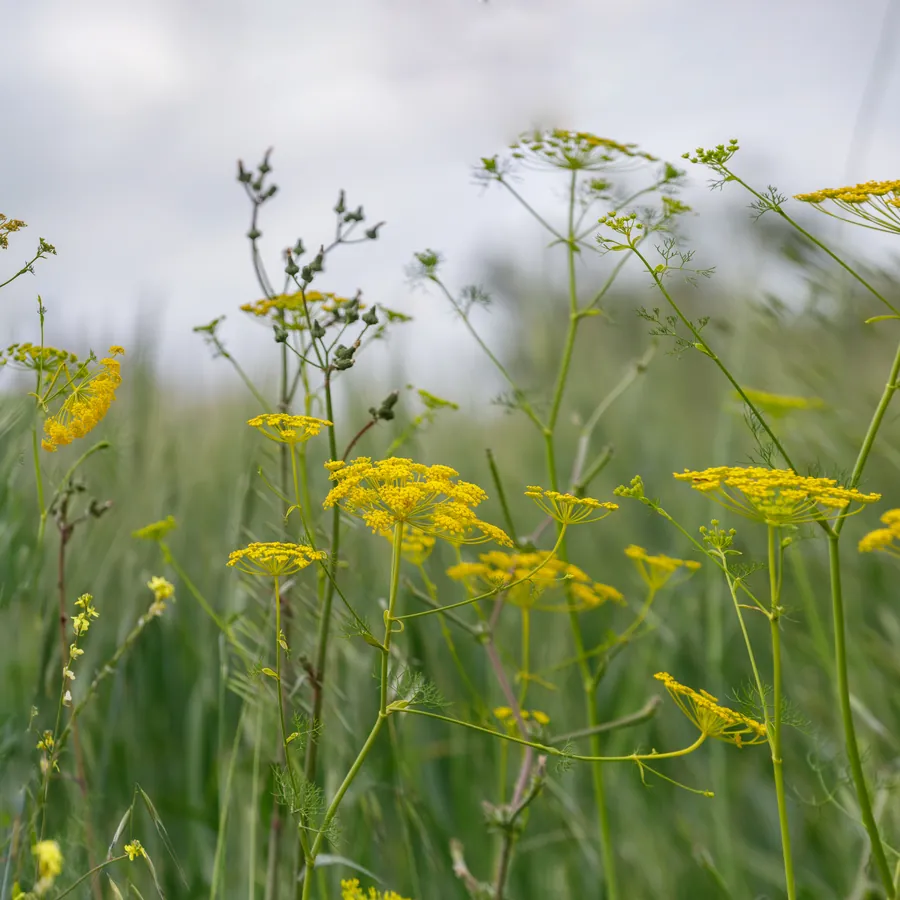
The other half of this entry is what the plant is called in the shops. It is not a rose, and it does not grow at Jericho; the nearest place it could be found is down by the Dead Sea, and most of what was sold in Jerusalem appears to have been carted in from Egypt. The authors quote the old herbalist Gerarde on the name: “the coiner spoiled the name in the mint.” A plant named by the people who bought it, for a place it does not come from, and sold back at the door of the church — while the women who actually used it called it something else entirely. The same thing happened to the cyclamen, and to the anemone, and to the wild carrot.
09The older strata
The cultural layer on some of these plants is much older than any of the above, and this matters for a specific argument.
The hannun's association with blood and with the dead is not a modern political reading laid over an older pastoral symbol. It runs back through Arabic — where النعمان is itself a word for blood — into the Canaanite and Phoenician substrate of the same ground, to the blood of Adonis and the scattered blood of Ba'al. The flower was carrying murder and resurrection in this soil before there was a written language here to record either (Record 01, Register 03).
The point is not antiquity for its own sake. It is that when a Palestinian today calls the hannun the flower of the martyrs, that is the oldest meaning the plant has, arriving at its most recent name — not a symbol newly recruited to a cause.
10And what gets taken
A hub about Palestinian plant culture that stopped at proverbs and paintings would be telling half the story, because this material has been systematically absorbed.
The fullest documented case in this record is the cactus. In Hebrew the plant is tsabar, and the same word is the standard term for a Jewish Israeli born in the country. That image was built out deliberately — a cartoon everyman in the 1950s, a talking cactus puppet on children's television from 1976, and outward as a national brand. Writing in BADIL's own journal, the Israeli researcher Tal Dor sets out what the appropriation accomplishes: the everyday sight of the cactus, she argues, does not raise questions about Palestinian life. It erases them (Record 04, Register 06).
Palestinian writers place this in a broader documented pattern — the same absorption applied to hummus, to falafel, and to embroidery itself. Naming it is not a complaint about borrowing. It is a description of a mechanism: evidence of Palestinian presence, converted into scenery.
11Where to find it
Which cultural register each plant in the record actually carries:
| Plant | Species | Carries | Where |
|---|---|---|---|
| الحنون | Anemone coronaria | Proverb, dal'ouna, tatreez, the martyr, the Canaanite substrate | Record 01 · Registers 03–04 |
| الصبّار | Opuntia ficus-indica | Folk song, four painters, the Nakba map, appropriation | Record 04 · Registers 04–06 |
| الزيتون | Olea europaea | Inheritance, the ancestor and witness, poetry | Record 03 · Register 04 |
| بخّور مريم | Cyclamen persicum | Naming — six local names, and the Marian one | Record 02 |
| السحلب | Anacamptis pyramidalis | A lexicon that names by use, and its silences | Record 07 · Register 01 |
| الكبّار | Capparis spinosa | Many names, which is what long use leaves behind | Record 05 · Register 01 |
| سيف الغراب | Gladiolus italicus | A sword, a beak, a field iris — names taken at arm's length | Record 09 · Register 01 |
Sources
- Palestinian Embroidery: a rich and diverse national heritage — palquest, Interactive Encyclopedia of the Palestine Question · Institute for Palestine Studies
- Tatreez patterns — collection — The Palestinian Museum, Birzeit
- الصبر والصبّار في الهوية الفلسطينية... وتغلغل "التسابار" الإسرائيلي — لؤي وتد ونور قربي، رصيف22
- نبات الصبار يدرك ما لا يدركه الصهاينة — تال دور، جريدة حق العودة · بديل
- T. Canaan, “Plant-lore in Palestinian Superstition,” The Journal of the Palestine Oriental Society 8 (1928): 129–168 — the place-name and personal-name lists at 131–132, and the personified plants; read at source
- T. Canaan, “Mohammedan Saints and Sanctuaries in Palestine,” JPOS 4 (1924): 1–84 — the carob, the jinn and the kharrub / kharraba root, 36–38; read at source
- G. M. Crowfoot and L. Baldensperger, “The Rose of Jericho,” JPOS 11 (1931): 7–14 — كفّ مريم, the birth charm and the pilgrim trade; read at source
- Omar Imseeh Tesdell, introductory essay in Palestinian Wild Food Plants — مركز خليل السكاكيني الثقافي + الصندوق العربي للثقافة والفنون، ٢٠١٨ · on who produced the documentary record
- Plus the sources cited on each record linked above — see Records 01, 03 and 04 for the proverb, song and painting citations in full.